
St Martin'sCE Primary School
History
Helping every child understand the past, their place in the world and the stories that connect us.
Our vision
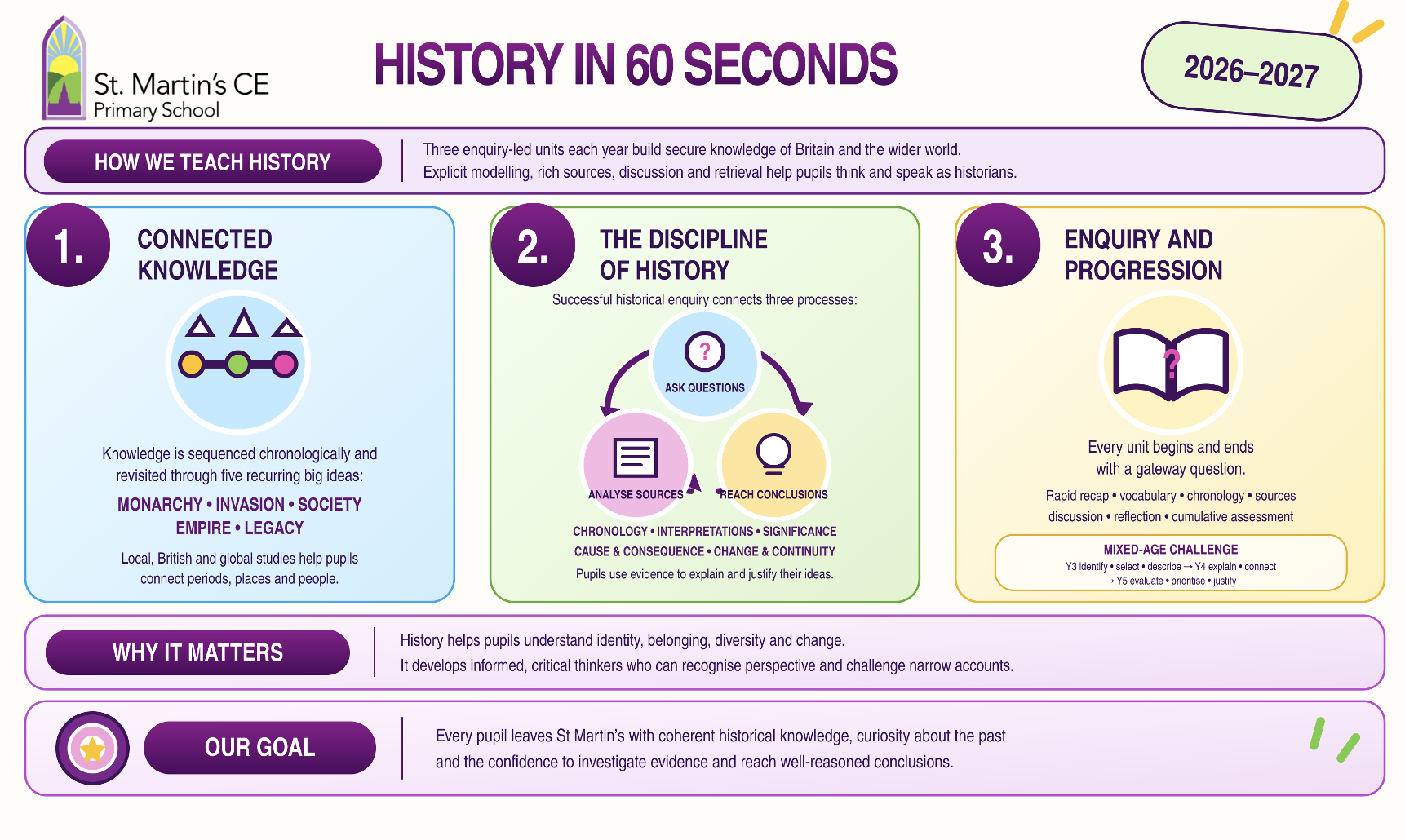
At St Martin's, history is ambitious, inclusive and rooted in enquiry. Pupils build a secure knowledge of Britain's past and the wider world, learn to ask worthwhile questions, examine evidence, consider different interpretations and reach reasoned conclusions. We want every child to become a curious and critical historian who can connect past events with the world they know today.
A coherent curriculum for our school
Pupils study three history units each year. Every unit is shaped by a gateway question and placed within a clear chronological framework. Knowledge is deliberately revisited so that pupils connect new learning to what they already know and remember more over time.
|
Phase |
Curriculum route |
|
Reception and Year 1 |
A two-year programme rooted in Understanding the World and designed to build securely towards Key Stage 1 history. |
|
Year 2 |
A standalone programme that consolidates Key Stage 1 and prepares pupils for the wider chronology and disciplinary challenge of Key Stage 2. |
|
Years 3, 4 and 5 |
A three-year rolling programme that secures full National Curriculum coverage without repetition. Pupils share the core enquiry while year-specific outcomes increase the level of historical thinking. |
|
Year 6 |
A standalone programme that draws together prior learning through global, local and thematic studies.
|
What pupils learn
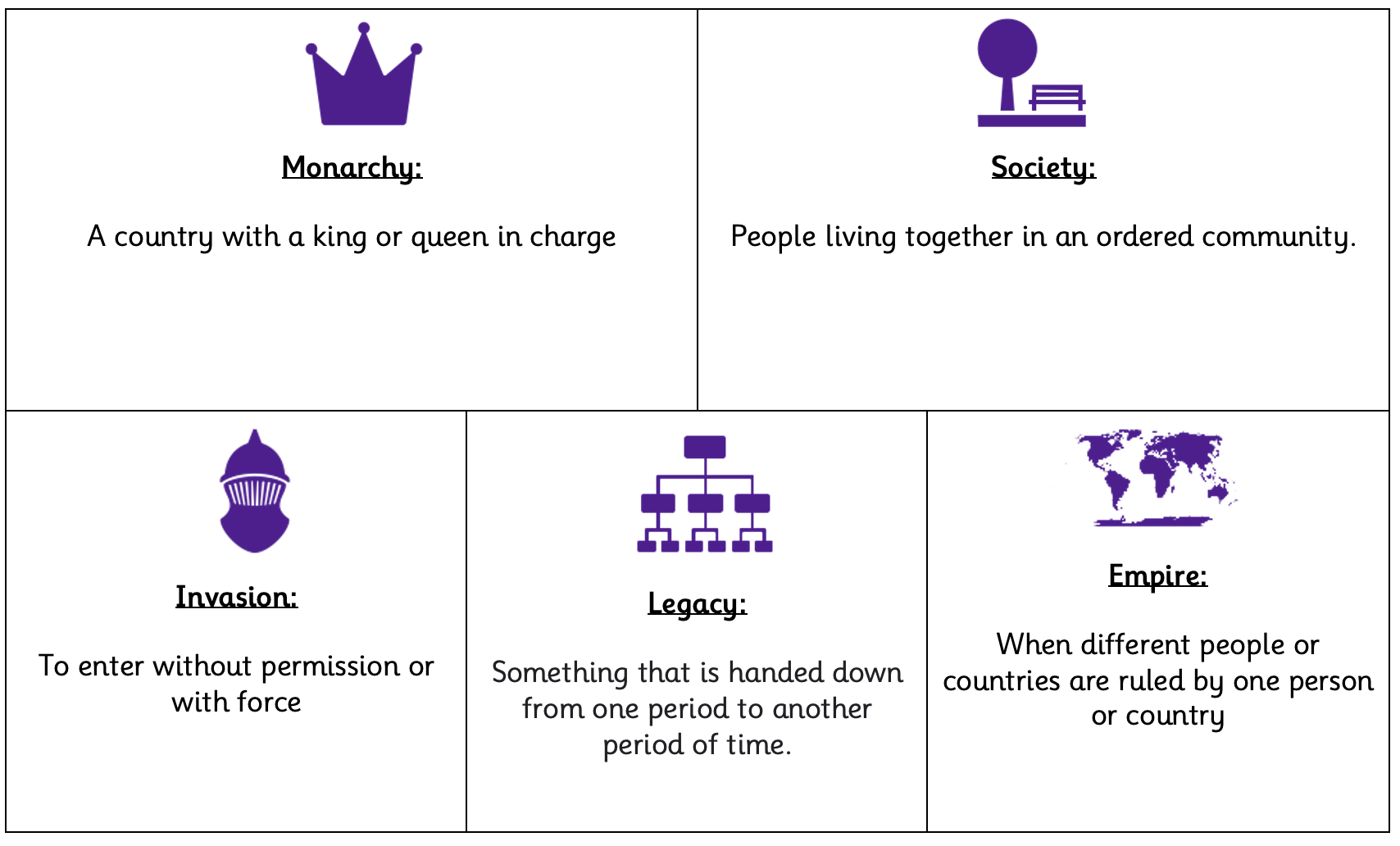
Substantive knowledge is organised through five recurring big ideas: Monarchy, Invasion, Society, Empire and Legacy. These lenses help pupils make connections across periods, places and civilisations.
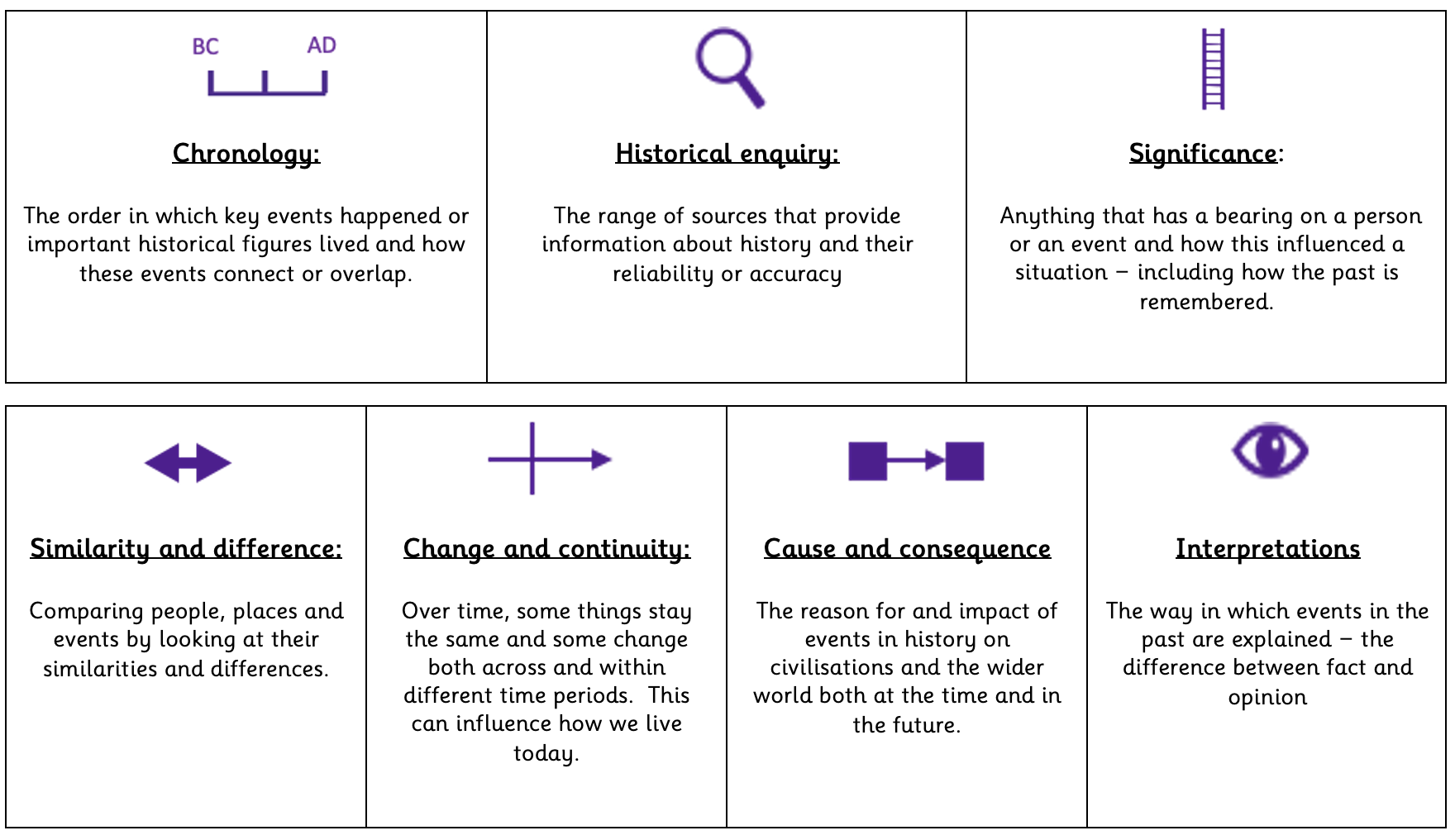
Alongside this knowledge, pupils learn how historians work through: Chronology, Historical Enquiry, Interpretations, Change and Continuity, Cause and Consequence, Similarity and Difference, and Significance.
How history is taught
History is taught in carefully planned blocks during alternate terms, with at least two dedicated sessions each week. A typical sequence includes:
- a rapid recap that retrieves prior learning and helps teachers identify what pupils remember;
- a focused enquiry question and explicit historical concept;
- careful teaching of subject vocabulary, including word origins where helpful;
- secure chronological context, rich historical knowledge and purposeful use of sources;
- discussion, explanation and tasks that require pupils to think historically; and
- reflection that returns to the enquiry and strengthens connections over time.
Knowledge organisers identify the essential knowledge and vocabulary for each unit. Carefully chosen artefacts, texts, school trips, local studies and visiting experts deepen pupils' understanding and bring the subject to life.
Challenge and progression in mixed-age classes
Pupils in mixed-age classes study the same core enquiry, but the disciplinary demand is deliberately different. In Years 3 to 5, pupils progress from identifying, selecting and describing, to explaining, connecting and cross-referencing, and then to evaluating, prioritising and justifying. This keeps the shared curriculum ambitious for older pupils while giving younger pupils the foundations they need.
Diversity, Belonging and Inclusion
Our History curriculum reflects our diverse school community and helps pupils understand themselves, Salisbury, Britain and the wider world. Local studies, global civilisations, thematic enquiries and our Hidden Figures lessons introduce pupils to people and perspectives that have too often been overlooked. Pupils learn to challenge narrow accounts of the past and understand why experiences and interpretations can differ.
All pupils, including those with SEND and pupils learning English as an additional language, study ambitious historical content. Teachers adapt explanations, vocabulary teaching, resources, scaffolds and ways of recording so that pupils can participate successfully without reducing the intended knowledge or historical thinking.
How do we know pupils are learning?
Assessment is woven through teaching and is used to improve learning. Teachers:
- use pupils' first response to the gateway question to identify prior knowledge and misconceptions;
- check recall through rapid recaps and cumulative quizzes;
- listen to pupils' explanations and examine their use of evidence, vocabulary and disciplinary concepts;
- judge mixed-age work against distinct year-group expectations; and
- return to the gateway question at the end of the unit so pupils can show how their knowledge and historical thinking have developed.
The intended impact is that pupils remember important knowledge, make increasingly sophisticated connections and use evidence to explain and justify their ideas with growing independence.


Curriculum documents
For further detail, please see our History Curriculum Statement and History Curriculum Overview and other key documents.