St Martin'sCE Primary School
Phonics Curriculum Statement
“Research shows that when phonics is taught in a structured way - starting with the easiest sounds and progressing through to the most complex – it is the most effective way of teaching young children to read. It is particularly helpful for children aged 5–7. Almost all children who receive good teaching of phonics will learn the skills they need to tackle new words. They can then go on to read any kind of text fluently and confidently, and to read for enjoyment.” Department for Education
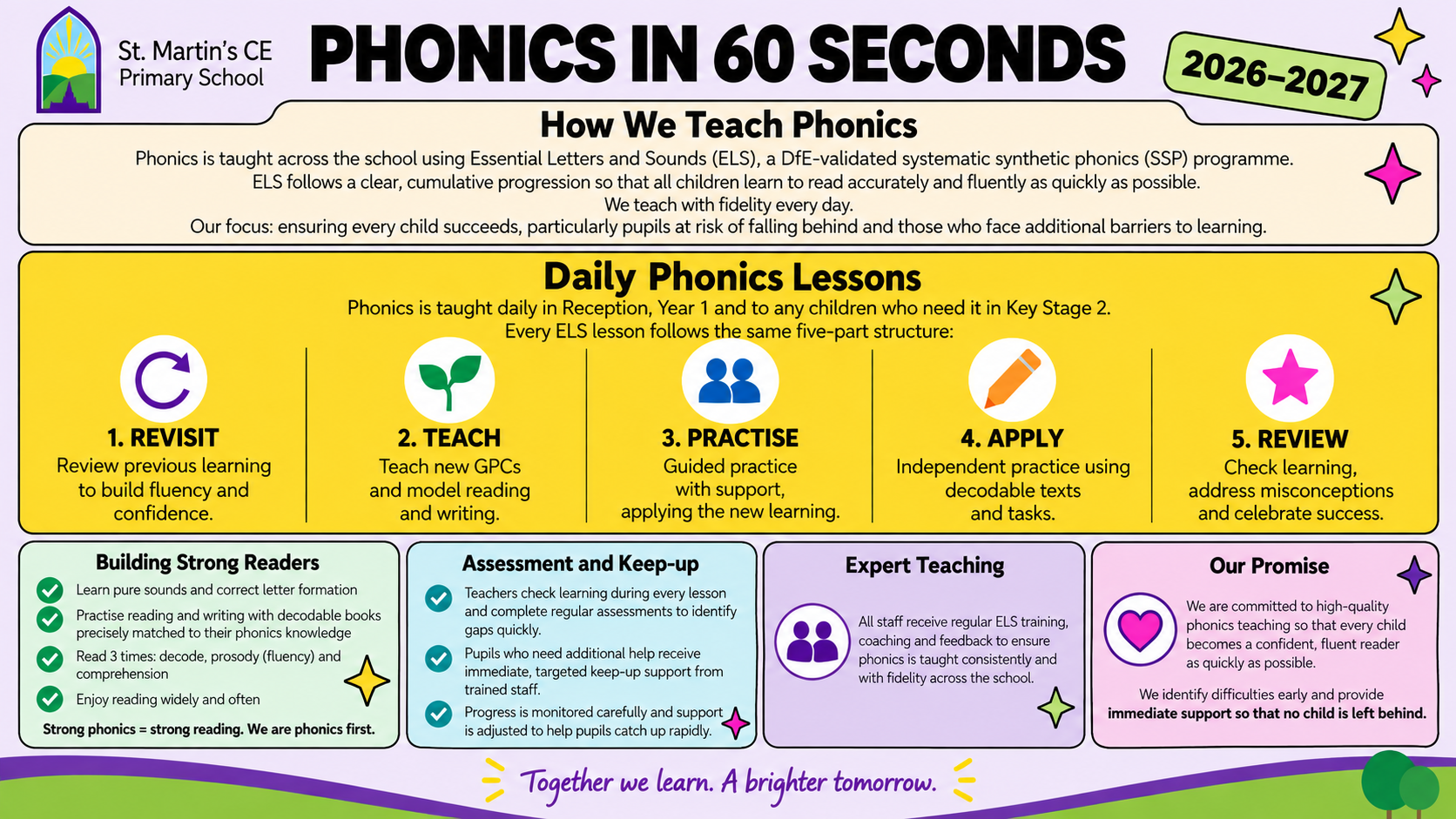
At St. Martin's, teachers follow the Essential Letters and Sounds (ELS) Systematic Synthetic Phonics programme, validated by the Department for Education.
ELS teaches children to read using a systematic synthetic phonics approach. It is designed to be used as part of a learning environment that is rich in talk and story, where children experience the joy of books and language whilst rapidly acquiring the skills to become fluent independent readers and writers.
ELS teaches children to:
• decode by identifying each sound within a word and blending them together to read fluently.
• encode by segmenting each sound to write words accurately.
ELS whole-class, daily phonics teaching begins from the first days of Reception. Through the rigorous ELS teaching programme, children build an immediate understanding of the relationship between the sounds they can hear and say (phonemes) and the written sounds (graphemes).
A key feature of the ELS programme is practice and repetition. Every single aspect of the lesson is modelled for children and they have many opportunities to:
• Hear the sound or word
• Say the sound or word
• See the sound or word
• Read the word
• Write the word
• Use new vocabulary.
Phases of ELS
Phase 1 - Experimenting with sounds.
Children identify sounds through play and experimentation. They are encouraged to listen to and discern the difference between sounds and create a wide range of sounds for themselves.
Phase 2
The children will be learning individual sounds and developing their skills at blending and segmenting these sounds for spelling and reading. At this stage parents should be encouraging their children to play sound games and practice sounds at home i.e. I-Spy. At this stage children begin to make CVC (Consonant, Vowel, Consonant) words i.e. cat.
Phase 3
Once the children know all their letters, common sounds such as sh, th, st, pr, and ch are introduced.
At this stage parents should be encouraging their child to blend and segment words when they are playing games with words and /or reading. At this stage children practise making CVC (Consonant, Vowel, Consonant) words i.e. cat and begin to make CCVC (i.e. ship) and CVCC (i.e. much) words.
Phase 4
Common end sounds i.e. ng, ll, ff, ld,.lp are introduced.
At this stage parents should be encouraging their child to blend and segment words when they are playing games with words and /or reading.
At this stage children practise making CCVC (i.e. ship) and develop their range of CVCC (i.e. mend) words.
Phase 5
The sounds represented by more than one letter are taught i.e. ai, ea, ir etc.
At this stage parents should be encouraging their child to blend and segment words when they are playing games with words and /or reading. The children are now developing their knowledge and skills with vowel diagraphs( two vowels that when put together make a new sound) such as ai as in maid, ea as in bear and ir as in bird. They also work with split vowel diagraphs such as a-e as in fare.
Phase 6
Children will learn word families and review their knowledge. The children at this stage and beyond develop their spelling further and meet the full range of spelling rules, develop knowledge of word roots and meanings and use common suffixes and prefixes to build their vocabulary.
The children work through each phase over a 6 week period and at the end of the phase their knowledge and skills are reviewed and next steps identified.
Beyond Phase 6
The children continue to be taught spelling and each year group is taught the statutory spellings alongside vocabulary to build their knowledge and experience further. This continues into Year 6 where the children are deepening their skills and knowledge ready for the transition to secondary.
Decodable Reading Books
Children who are learning to read through phonics take home fully decodable books that are precisely matched to the sounds and words they have been taught through Essential Letters and Sounds. This includes older pupils who have not yet secured all the phonics knowledge they need.
Teachers assess children’s reading regularly so that books are appropriately matched, gaps are identified quickly and additional support can be provided where needed.
Families can also access a wider selection of decodable books through our online eBook library. These books are matched to children’s phonics learning and provide further opportunities to practise successfully at home. Login details are available from your child’s class teacher.
Why Does My Child Reread the Same Book?
Purposeful rereading is an essential part of learning to read fluently. When children first encounter a decodable book, they concentrate on applying their phonics knowledge to decode each word accurately. Repeated reading helps word recognition become quicker and more automatic, allowing children to focus increasingly on expression and understanding.
Children are encouraged to read each book several times, with a different focus:
-
Decoding: reading every word accurately using phonics.
-
Fluency and prosody: reading smoothly, at an appropriate pace and with expression.
-
Comprehension: discussing vocabulary and the meaning of the text.
A book that appears easy is often precisely matched to the knowledge a child needs to practise. Rereading builds accuracy, confidence, fluency and comprehension.
Year 1 Phonics Screening Check
During the summer term, all Year 1 children in England take part in the statutory Phonics Screening Check. The check helps us assess how securely children can apply their phonics knowledge and identify anyone who may need additional support.
Children are asked to read 40 real and pseudo-words by using their phonics knowledge to sound out and blend. The check is completed individually with a familiar adult in a calm and supportive environment, and we present it as part of children’s usual phonics learning.
Parents and carers are informed of their child’s result in their end-of-year report. Children who do not yet meet the national expected standard receive targeted support and complete the check again in Year 2.