
St Martin'sCE Primary School
Science
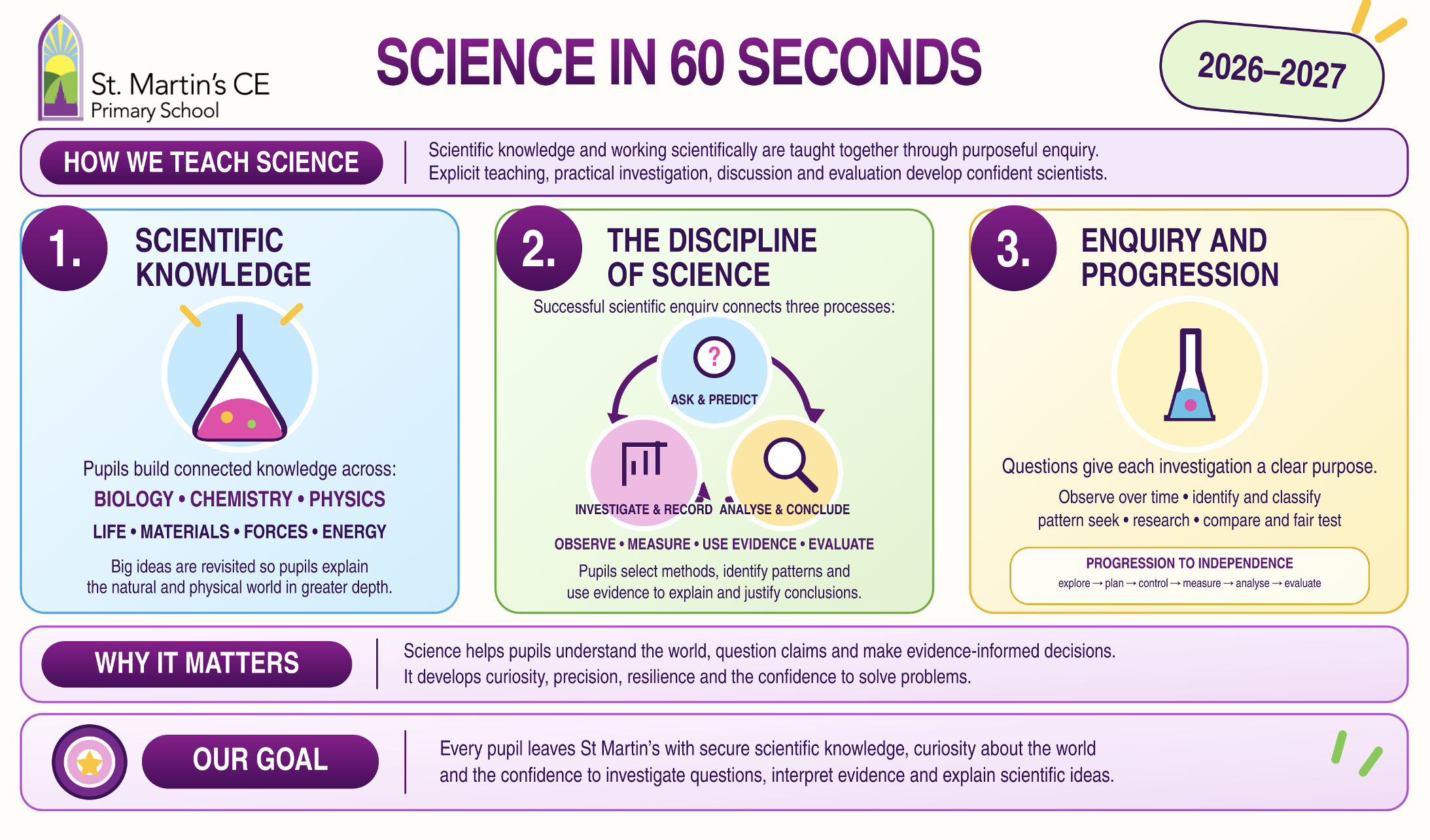
Developing curious, knowledgeable and increasingly independent scientists who can investigate, explain and evaluate the world around them.
Our vision
At St Martin's, science is ambitious, practical and rooted in enquiry. Pupils build secure knowledge across biology, chemistry and physics while learning how scientific knowledge is established. They ask questions, make predictions, investigate, observe, measure, record, analyse and use evidence to reach and evaluate conclusions.
A coherent curriculum from EYFS to Year 6
Our curriculum identifies the precise scientific knowledge and working-scientifically skills pupils should develop at each stage. Learning begins in EYFS through curiosity, exploration and observation of the natural world. Across Key Stages 1 and 2, concepts are revisited in increasingly demanding contexts so that pupils connect new learning to secure prior knowledge and apply it with growing accuracy and independence.
| Phase | Progression in scientific thinking |
|
EYFS |
Children explore their familiar world, ask questions, notice similarities and differences, make simple predictions and communicate what they observe. |
|
Key Stage 1 |
Pupils ask testable questions, follow and suggest simple enquiries, observe closely, use simple equipment, classify, record data and use findings to answer questions. |
|
Lower Key Stage 2 |
Pupils select enquiry approaches, set up comparative and fair tests, identify variables, measure more accurately, identify patterns and use results to draw conclusions. |
|
Upper Key Stage 2 |
Pupils plan investigations with increasing independence, control variables, select precise equipment, analyse more complex data, evaluate reliability and use evidence to justify conclusions and next steps.
|
What pupils learn
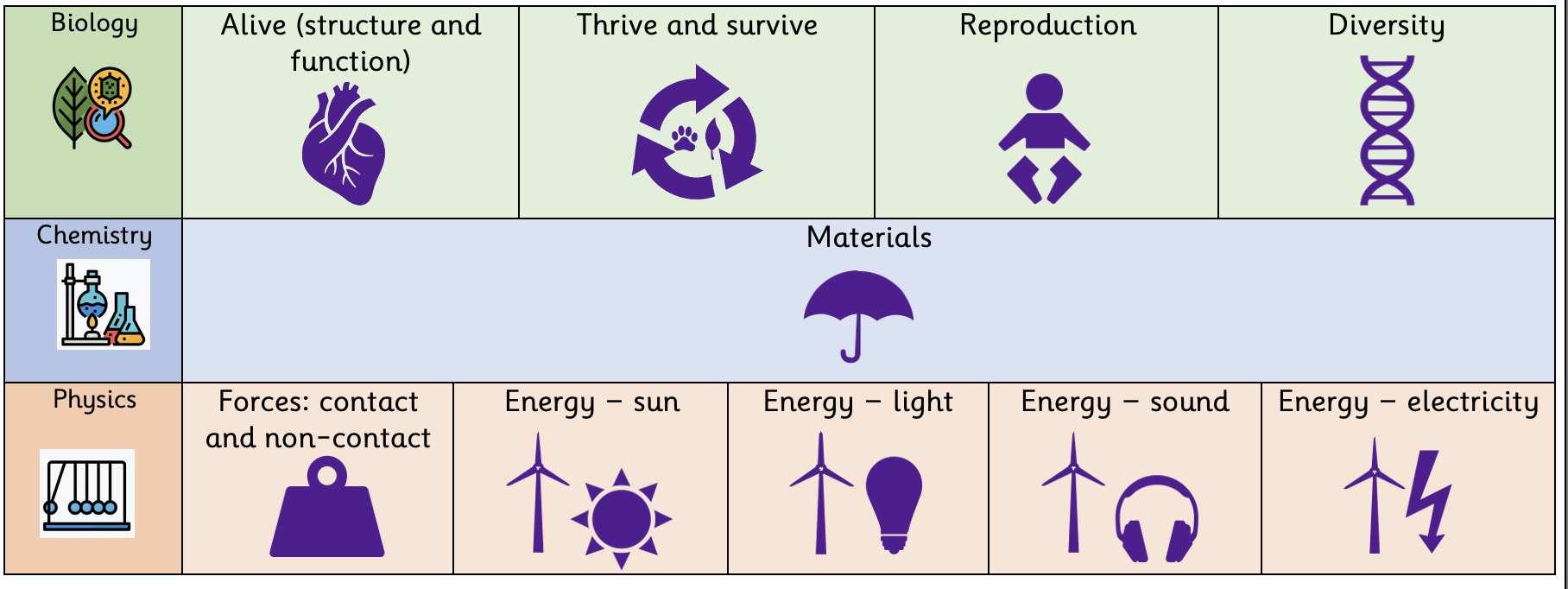
Substantive knowledge is organised through three scientific disciplines and recurring big ideas:
- Biology - Alive, including structure and function; Thrive and Survive; Reproduction; and Diversity;
- Chemistry - Materials, including their properties, uses and changes; and
- Physics - contact and non-contact Forces, and Energy through the sun, light, sound and electricity.
These big ideas help pupils connect learning across year groups. For example, early observations of animals, plants, seasons and materials become the foundation for later explanations of adaptation, life cycles, properties and changes, forces, energy and physical processes.
Working scientifically
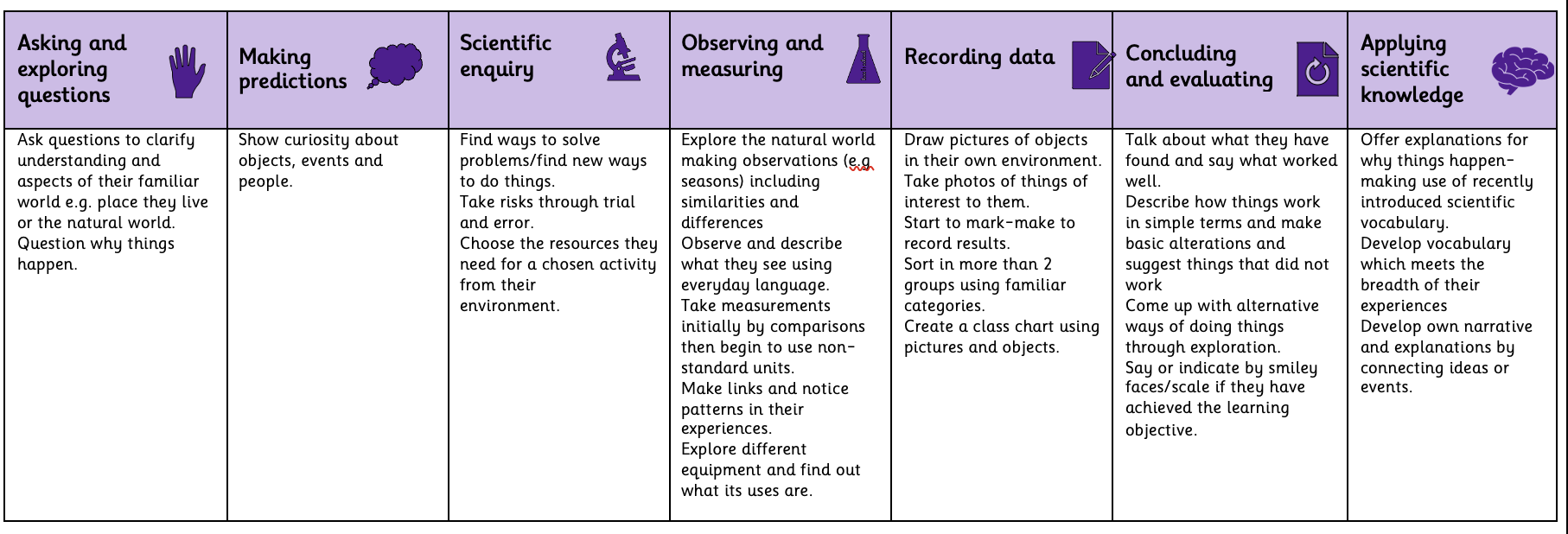
Scientific disciplinary knowledge progresses through seven connected concepts: Asking and Exploring Questions, Making Predictions, Scientific Enquiry, Observing and Measuring, Recording Data, Concluding and Evaluating, and Applying Scientific Knowledge.
These are taught through the science content rather than as isolated skills. Pupils therefore use relevant scientific knowledge to decide what to investigate, choose methods, interpret evidence and explain what their findings mean.
How science is taught
Units and lessons are shaped by meaningful enquiry questions. Teaching typically includes:
- retrieval of relevant prior knowledge and vocabulary;
- explicit teaching and modelling of new scientific concepts and methods;
- carefully chosen practical activity or enquiry where it strengthens understanding;
- purposeful observation, classification, measurement or data collection;
- structured opportunities to discuss patterns, relationships, causes and evidence; and
- conclusions that answer the enquiry question and evaluation of the method or evidence.
Pupils encounter different types of enquiry, including observing over time, pattern seeking, identifying and classifying, comparative and fair testing, and research using secondary sources. Practical work is purposeful: pupils understand both what they are doing and the scientific knowledge it helps them develop
Scientific vocabulary, mathematics and communication
Scientific vocabulary is taught explicitly so pupils can describe observations and explain ideas with increasing precision. Pupils apply relevant mathematical knowledge when measuring, reading scales, recording data and constructing or interpreting tables, charts and graphs. They communicate findings through talk, diagrams, labelled drawings, written explanations and increasingly complex data presentations.
Diversity, inclusion and access
Science introduces pupils to the contribution of diverse scientists and helps them understand that scientific knowledge is developed by people from different cultures, backgrounds and periods of history. All pupils, including those with SEND and pupils learning English as an additional language, study ambitious scientific content. Teachers adapt explanations, vocabulary teaching, equipment, recording methods and scaffolds while maintaining the intended scientific knowledge and thinking.
How do we know pupils are learning?
Assessment is woven through teaching and focuses on both what pupils know and how well they can work scientifically. Teachers:
- use questioning and retrieval to identify prior knowledge and misconceptions;
- observe pupils' practical decisions, use of equipment and ability to work safely and accurately;
- examine observations, measurements, tables, graphs, diagrams and written explanations;
- check whether conclusions answer the enquiry question and are supported by evidence;
- use year-specific expectations to judge progress within mixed-age classes; and
- revisit key ideas so pupils can demonstrate retention and make connections across units.
The intended impact is that pupils remember important scientific knowledge, use evidence confidently, carry out increasingly independent enquiries and understand how science helps us explain and influence the world.


Curriculum documents
For further detail, please see our Science Progression Document. It sets out the development of biology, chemistry and physics knowledge alongside the working-scientifically expectations from EYFS to Year 6.